
UAT Sandbox
The UAT Sandbox allows you to simulate end to end payment flows and test your integration thoroughly. It uses templates that map APIs to predefined sample responses, enabling you to simulate various scenarios such as payment Success, Failure, and Pending without real transactions.
Benefits of using the UAT Sandbox
- Even if the PhonePe UAT server is unavailable, the UAT Sandbox ensures a smooth testing experience. You can continue validating payment flows without disruptions.
- Simulate various payment outcomes such as success, failure, and pending states. This helps ensure your integration handles all real-world scenarios reliably.
- Thoroughly test the entire payment lifecycle from initiation to response. This ensures a stable and seamless experience when you move to production.
Android Test App
Download and install the PhonePe Test app to verify the flows in UAT.
- Android – Download from here [Package Name: com.phonepe.simulator]
- For Android, in the SDK, set the environment value as SANDBOX to test payments.
- Android SDK Version: 5.2.0.
Test App Setup
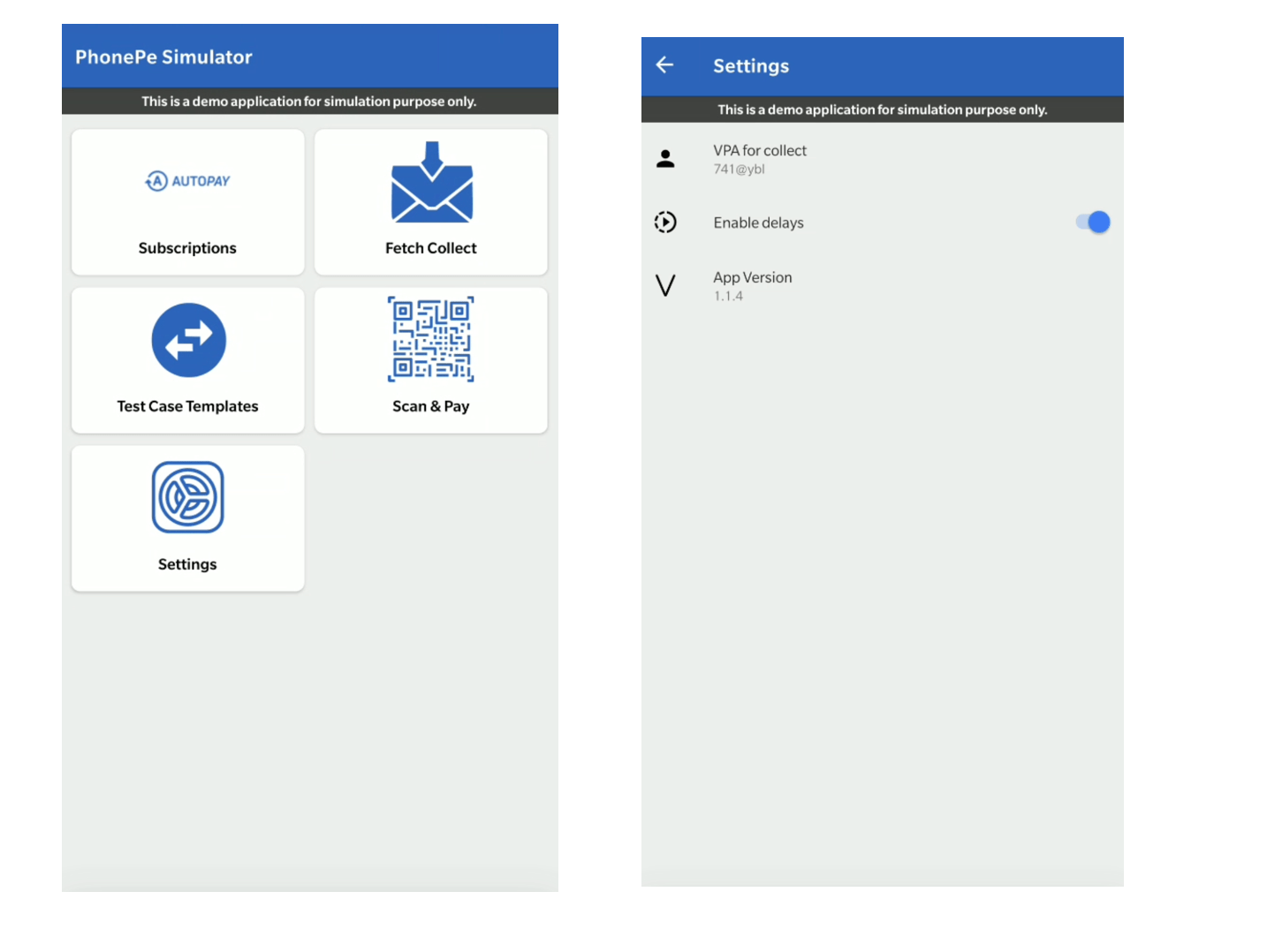
- Click on “Settings” and configure the “VPA for Collect” like @ybl that can be used for testing the UPI Collect Flow.
Once the collect request is raised, then click on “Fetch Collect” to see the collect request in the PhonePe Test app and click “Pay” to complete the transaction. - Click on “Test Case Templates” to configure the Success, Failure, or Pending templates to receive the response accordingly.
By default, the Success template will be set and you will always get the Success Response.
Configure Template
Download the Demo Video – Here
To configure the required template,
- Open the PhonePe Test App and Select the “Test Case Templates” button.
- Enter the “Merchant ID” and click “GET CONFIGURED TEMPLATES”
- Enter the “Merchant ID” and click “GET CONFIGURED TEMPLATES” to fetch the current templates if already set. Else, you will get “No Template Configured”
- For PG Integration, use the “Flow: Custom & Standard Checkout V2” to configure the required template for Success, Failure, or Pending scenarios
Steps to Configure Template

Make sure to set the right templates for the Custom Checkout integration.
The templates of Custom Checkout integration starts with the KeyWord: “Custom“
Templates for each type of Payment Method
Consent Linking for Saved Instruments for Android
View the Saved Instruments after Linking for AndroidWhat’s Next?
Now that you have successfully completed UAT testing and verified your integration, it’s time to move to the Production environment. The next section provides the complete checklist for taking your integration live.


